The Infinite Canvas: Why AI Cannot Steal What Was Never Owned
The Infinite Canvas: Why AI Cannot Steal What Was Never Owned By Michael — Founder of Kactuz Light Music
There is a number so large it has no name. It is the number of all possible songs that could ever be written. Not the songs that have been written — the songs that could be. And when you actually sit down and calculate it, something happens to you. The courtroom arguments, the headlines about AI stealing music, the panicked op-eds from industry lawyers — they all start to feel a little like watching someone guard a single grain of sand on a beach that stretches to infinity. I know this feeling personally, because I've stood on that beach.
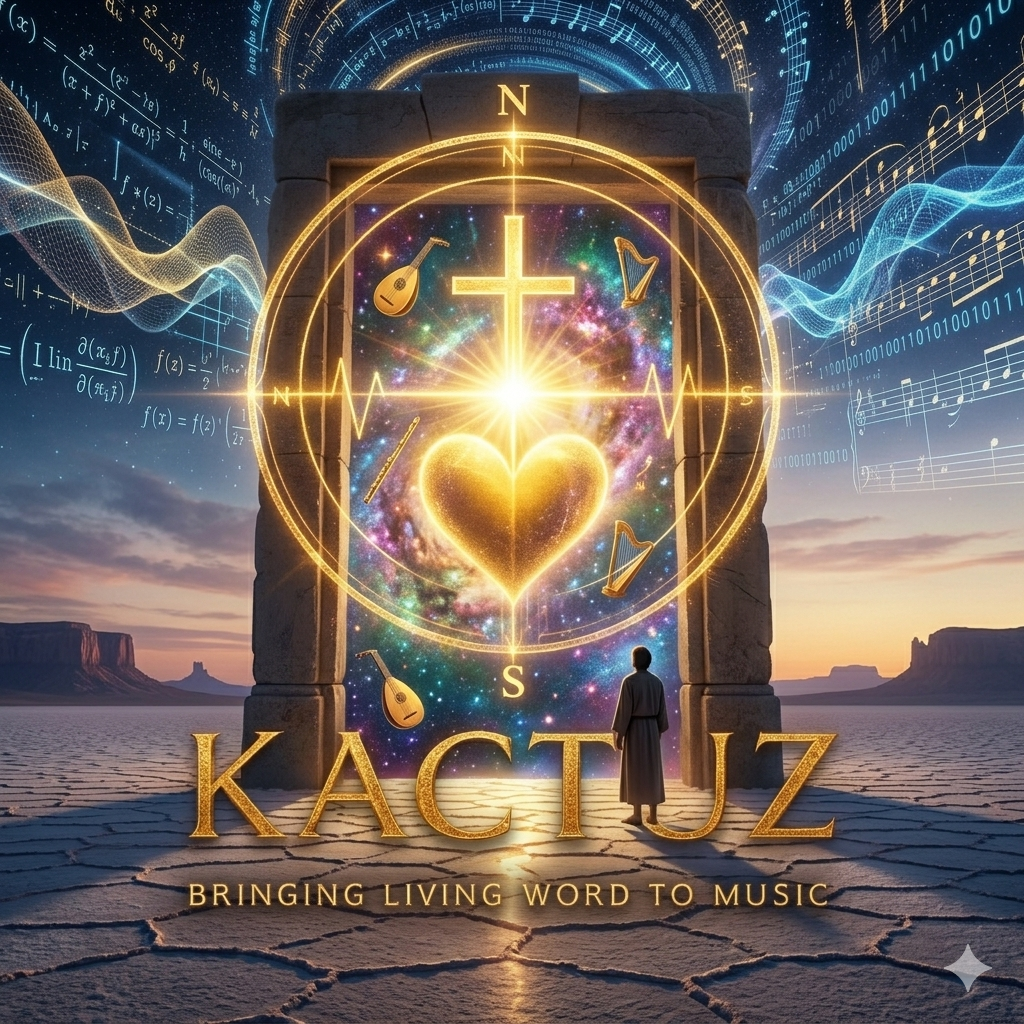
A Ministry, a Desert, and a Different Kind of Music My name is Michael. I run Kactuz Light Music — KACTUZ — a faith-based music ministry based in Denmark, where I write, compose, record and mix everything myself. I give it all away for free at kactuzmusic.com, because that was always the point. The ministry began Christmas Eve 2023 after watching The Chosen, and something in me fundamentally reoriented. Music stopped being about commercial pursuit. It became something closer to prayer in motion. The name KACTUZ is not an accident. A cactus survives where almost nothing else can. It stores what it needs. It blooms in the harshest conditions. It does not ask permission from the desert to grow there. That felt right. Over the past two years I have built an entire sonic world from that posture — albums drawn from the Psalms, from Revelation, from Paul's letters, from the prophetic books. Confess and Repent — Jesus Is Our God. Songs of Ascents. Spirit in Motion. Twelve tracks at a time, built around multigenerational testimonies, including a concept album that begins with my grandmother Sara, born in Jujuy, Argentina in 1912. A woman who never heard the music I make, but whose life runs like a root system beneath all of it. I work with Suno AI. I use OpenArt for visuals. I prompt, I listen, I reject, I refine, I layer in my own vocals, my own theology, my own sense of where a melody should breathe and where it should push. And somewhere in that process, I became something I never expected to become. I became a producer.
What AI Actually Did For Me Here is what nobody tells you about AI music tools: they do not replace your ear. They expose it. Before AI, the gap between what I heard in my head and what came out of my hands was enormous. I am not a trained musician in the classical sense. I did not go to conservatoire. I could not sit down at a piano and play what I felt. That distance — between imagination and execution — kept a ceiling on everything. Suno removed the ceiling. Suddenly I could generate a sonic sketch in minutes and spend my real energy on what only I could bring: the theological depth, the lyrical architecture, the decision of where spoken word should land, where silence earns its place, when the groove should be pushed from 80 BPM to 95 because the Holy Spirit doesn't always move at a comfortable tempo. I could hear my own instincts clearly for the first time, because the technical barrier was no longer in the way. I felt, genuinely, like a super-producer. Not because the AI made great music for me. But because it handed me a palette large enough that my actual taste — my actual calling — could finally show up fully. And this, I think, is the thing the music industry has completely misunderstood in its rush to the courtroom.
The Math They Are Not Talking About Let me give you a number. If you take just the audible range of musical pitches — roughly 120 across ten octaves in the twelve-tone system — and arrange them across the time slots of a single three-minute song at a standard 120 BPM resolution, you get a space of possible melodies equal to approximately 10 to the power of 3,000. That is a one followed by three thousand zeros. For context, the total number of atoms in the observable universe is roughly 10 to the power of 80. The number of possible melodies alone is so far beyond that figure that the comparison is almost meaningless. Add chords — ten simultaneous notes across those same time slots — and you are past 10 to the power of 23,000. Add instruments, dynamics, tempo variation, timbre, silence used as rhythm, and you are looking at a number with over 100,000 digits. The entire recorded output of human musical history — every song ever committed to tape, vinyl, streaming — sits at approximately 100 million pieces. Call it 10 to the power of 8. The fraction of possible music that humanity has ever created is so small it cannot be meaningfully expressed as a percentage. It is essentially zero. The musical universe is not a finite pool being slowly depleted. It is an infinite canvas on which we have collectively drawn one very small picture in one very small corner. You cannot steal from infinity.
What the Lawsuits Are Really About I understand the fear. I do. Artists spent decades building careers on a system that valued their particular execution of musical ideas. Now a tool exists that can approximate the surface texture of those executions at speed and scale, and it feels like an existential threat. But the legal argument — that AI models have stolen music by training on it — is built on a false premise: that music is a finite resource that can be used up or taken. It cannot. What AI systems have absorbed is not the music itself. It is the grammar of music. The patterns, the relationships between intervals, the conventions of how tension resolves, how rhythm breathes, how a verse earns its chorus. That grammar belongs to no one. It is a shared human inheritance stretching back to the first person who noticed that certain combinations of sound created feeling. Trying to own music theory is like trying to own language because you wrote a novel.
The New Producer Must Be Something Different What this moment actually demands — and what I believe the next generation of music-makers must develop — is not technical skill in the old sense. It is something closer to taste as a discipline. The future producer needs two things working simultaneously. They need the ear of Simon Cowell — that cold, clear, merciless ability to hear whether something works, stripped of sentiment, stripped of ego, stripped of the relationship with the person who made it. The ability to sit with a piece of music and know, without needing anyone's permission, whether it is true or whether it is pretending. Cowell's great gift was never cruelty. It was clarity. And they need the feel of Michael Jackson — that innate understanding that music is not organized sound, it is organized emotion. The knowing that a single misplaced snare destroys a moment. That silence is an instrument. That the human body responds to rhythm before the mind processes it, and that if the groove isn't right, nothing else matters. Jackson did not just perform music. He inhabited it so completely that the boundary between him and the song disappeared. AI gives you the tools. But it cannot give you the ear, and it cannot give you the feel. Those come from living, from listening with obsessive attention, from caring about music the way you care about something sacred. For me, that sacred dimension is literal. I make music for a calling I did not choose. The ministry chose me on a Christmas Eve when something cracked open and the songs started coming. Since then every track, every album, every visual, every spoken word passage has been an act of faith — offered freely, carried forward by something larger than production software. KACTUZ is not a brand strategy. It is a cactus blooming in a desert, because that is what it was made to do.
The Territory Ahead We are at the very beginning of something. The musical territory that human beings have explored — all of it, across every culture, every century, every genre — represents a nearly invisible mark on a canvas that stretches beyond what mathematics can comfortably describe. Most of what is possible has never been heard. Most of the melodies that will move people to tears do not exist yet. Most of the rhythms that will make bodies move have not been constructed. AI did not steal that territory from anyone. It opened the door wider. The question the music industry should be asking is not who owns the past — it is who has the taste, the vision, and the courage to explore what comes next. I know where I will be. In the desert, growing.
Michael is the founder of Kactuz Light Music, a faith-based music ministry distributing all music freely at kactuzmusic.com